

Aircraft instruments are critical to safe and efficient flight. From basic airspeed readings to digital navigation systems, these tools give pilots the data they need to maintain control and situational awareness.
Mechanical or digital, each instrument has a specific role within the cockpit.

What Are Aircraft Instruments?
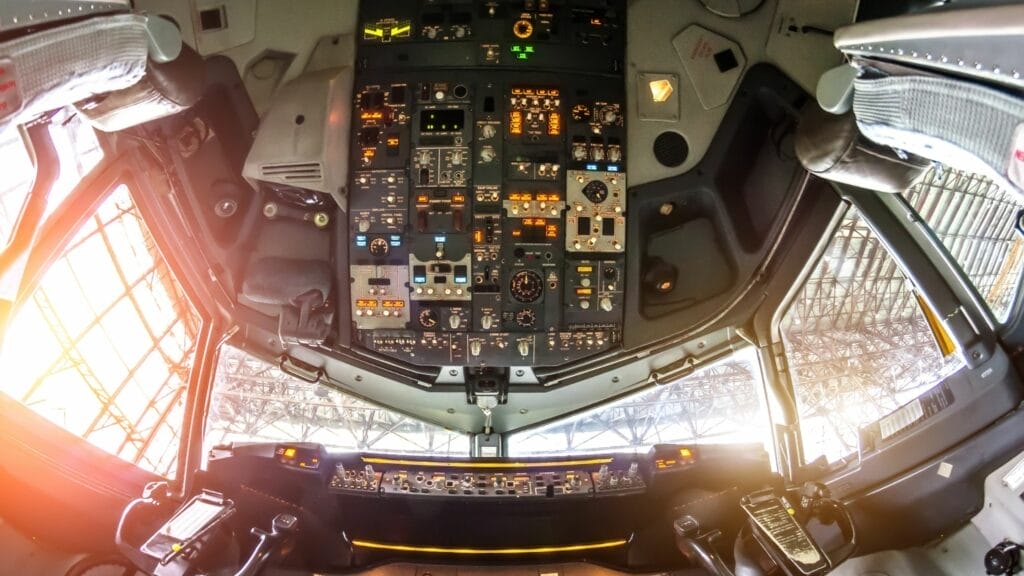
Aircraft instruments are installed within the cockpit. They provide critical flight, engine, and navigation information. Furthermore, they gather data such as air pressure, altitude, orientation, and engine performance. They help pilots make informed decisions and maintain safe flight conditions.
Generally, most instruments are grouped by function into three categories:
- Flight Instruments
- Engine Monitoring Instruments
- Navigation and Avionics Displays
The Six Basic Flight Instruments
Pilots rely on a standard set of six primary instruments during flight. These instruments offer real-time data on aircraft orientation, speed, and motion. Together, they support safe flight—especially in reduced visibility.
Airspeed Indicator
The airspeed indicator shows the aircraft’s speed as it moves through the air. It uses the pitot system, which measures dynamic air pressure, and compares it to atmospheric pressure from the static system. The difference gives a reading in knots or miles per hour.
The needle points to colored ranges:
- White arc: flaps-down operating range
- Green arc: normal operating range
- Yellow arc: caution range (smooth air only)
- Red line: never exceed speed (Vne)
Understanding this indicator helps prevent stalls and overspeed conditions.
Attitude Indicator
Commonly known as the artificial horizon, the attitude indicator shows the aircraft’s pitch (nose up or down) and bank (left or right). It works using a gyroscope mounted horizontally, staying fixed while the aircraft moves.
This instrument becomes vital during night flights or in cloud cover, where the true horizon isn’t visible. Without it, it’s hard to detect gradual banks or pitch changes that may lead to disorientation.
Altimeter
The altimeter shows height above mean sea level (MSL). It reads atmospheric pressure from the static system and converts it into altitude.
Pilots must adjust the altimeter to local barometric pressure settings regularly. Incorrect settings can result in altitude errors, which may impact aircraft separation or controlled airspace compliance.
Turn Coordinator
The turn coordinator shows how fast the aircraft is turning and whether a turn is coordinated. It combines two functions:
- Turn rate indicator (yaw)
- Inclinometer (balance of the turn)
If a turn is uncoordinated, the aircraft may skid or slip, reducing control effectiveness. This instrument uses a small gyroscope and a liquid-filled tube with a ball (the inclinometer).
Heading Indicator
The heading indicator (directional gyro) shows magnetic heading in degrees. It offers more stable and accurate readings than a magnetic compass, which often swings during turns or climbs.
Pilots align the heading indicator with the magnetic compass regularly to correct for minor drifts. It’s especially useful when navigating via headings or tracking VOR (VHF Omnidirectional Range) signals.
Vertical Speed Indicator (VSI)
The vertical speed indicator displays how fast the aircraft is climbing or descending. It works using pressure changes in the static system, typically showing rates in feet per minute (fpm).
While the altimeter tells altitude, the VSI indicates how fast that altitude is changing. This helps during level-offs, approaches, or maintaining vertical separation from other traffic.
Related Article: How Airplane Cabin Pressurization Works

Engine Monitoring Instruments
Engine instruments help pilots monitor the aircraft’s powerplant(s). These readings alert the pilot to abnormal operation so they can act before a failure occurs.
Tachometer
The tachometer measures engine revolutions per minute (RPM). In piston engines, it’s a direct readout of how fast the crankshaft is spinning. In turbine aircraft, it often measures compressor speed as a percentage of maximum RPM.
Changes in RPM help pilots set cruise settings, reduce wear, and diagnose irregularities such as misfires or propeller issues.
Manifold Pressure Gauge
Found in aircraft with constant-speed propellers or turbocharged engines, this gauge shows air pressure inside the engine’s intake manifold. It reflects engine power when combined with RPM readings.
Pilots use the manifold pressure gauge to set climb, cruise, or descent power accurately, avoiding overstressing the engine.
Fuel Flow Indicator
The fuel flow indicator gives the flow rate, typically in gallons per hour (GPH). It helps pilots manage fuel efficiency and plan legs based on expected fuel burn rates.
Oil Temperature and Pressure Gauges
Oil pressure shows the force pushing oil through the engine. Temperature gauges reflect how hot the oil gets during operation.
Low oil pressure or high oil temperature can signal mechanical wear, failed pumps, or blocked passages. Pilots routinely check these readings during pre-flight and in-flight checks.
Exhaust Gas Temperature (EGT)
The EGT gauge measures the temperature of exhaust gases as they leave the engine cylinders. It helps pilots set the optimal fuel-air mixture, especially in lean-of-peak operations at high altitude.
Precise EGT management improves fuel economy and engine longevity, particularly in naturally aspirated piston aircraft.
Navigation and Avionics Displays
Beyond controlling flight and engine settings, pilots must navigate and communicate. Navigation and avionics instruments support situational awareness and communication with air traffic control.
GPS Displays
Modern aviation GPS units offer highly accurate position, direction, and speed information. They display:
- Current coordinates
- Waypoints and routes
- Terrain and airspace boundaries
- Nearby obstacles
GPS has become the cornerstone of modern navigation, providing en route guidance and approach capability, even in low visibility.
Communication Radios
Radios enable the pilot to transmit and receive voice communication with ATC, ground services, and other aircraft.
Modern setups often include multiple radios, allowing simultaneous communication with ground stations and backup options in case of failure.
Transponders
A transponder transmits a coded signal in response to radar detection. It includes squawk codes and Mode C or Mode S capability, which also reports altitude.
Transponders are required in controlled airspace and contribute to traffic awareness and separation by ATC.
ADS-B Systems
ADS-B (Automatic Dependent Surveillance–Broadcast) is a system that transmits aircraft position, velocity, and heading using GPS-derived data.
Mandated in many countries for certain airspace, ADS-B increases visibility to other aircraft and improves collision avoidance tools.
Modern Digital Cockpit Displays
Advances in avionics have led to glass cockpit systems. These use digital screens instead of analog gauges to show flight and system data.
- Primary Flight Display (PFD): Merges key instruments like the airspeed indicator, attitude indicator, vertical speed, and heading indicator into one screen.
- Multi Function Display (MFD): Displays additional data, including GPS maps, weather radar, systems monitoring, and engine instruments.
- Glass Cockpit advantages
- Consolidated data for better clarity
- Easier scanning across systems
- Customizable views or alerts
- Lighter weight compared to mechanical instruments
- Improved diagnostics and logging
Why Aircraft Instruments Matter for Safety and Performance
Aircraft instruments serve as the pilot’s eyes and ears when outside visibility is poor or environmental conditions change suddenly. Even in visual conditions, instruments support efficient fuel use, stable engine operation, and navigational accuracy.
Instruments like the vertical speed indicator and artificial horizon help prevent unsafe maneuvers. Knowing your exact airspeed or pitch during a climb or descent means safer operation and compliance with airspace procedures.
Engine instruments also play a direct safety role. Undetected overheating, fuel imbalance, or loss of oil pressure can compromise flight if not corrected in time.
How Aircraft Instruments Work (Simple Breakdown)
The following systems support key aircraft instruments, each working on a reliable mechanical or electronic principle:
| System | Description |
| Pilot System | Measures dynamic air pressure using an external pitot tube. Supports the airspeed indicator. |
| Static System | Measures atmospheric pressure via a static port. Feeds the VSI and altimeter. |
| Gyroscopic Instruments | Use precession and rigidity in space principles. Instruments like the heading indicator, turn coordinator, and attitude indicator rely on this system. |
| Electronic Flight Instrument Systems (EFIS) | Use input from various sensors—including gyros and pressure sensors—to display digital data on glass cockpit screens (PFD and MFD). |
Where to Buy Aircraft Instruments
Aircraft instruments must come from trusted sources that meet airworthiness and regulatory standards. Choosing the right supplier means having access to certified components, up-to-date documentation, and reliable part history.
DK Turbines supplies a wide range of flight instruments, engine monitors, and avionics components for both fixed-wing and rotorcraft fleets. Their inventory includes FAA-certified and PMA-approved parts, with support for both legacy and current models.
Their online Parts Search tool makes it easy to find the aircraft instruments or component you’re looking for. Users can search by part number or description. Each listing includes traceability details, overhaul status, and availability.
Frequently Asked Questions
What are the main aircraft instruments?
Airspeed indicator, attitude indicator, altimeter, heading indicator, turn coordinator, and vertical speed indicator.
How do aircraft gauges work?
They convert pressure, movement, or electrical input into visual data using mechanical or digital systems.
What instruments are required for flight?
VFR requires airspeed, altimeter, compass, and engine gauges. IFR adds the attitude indicator, heading indicator, and turn coordinator.
What is a glass cockpit?
A setup using digital displays (PFD and MFD) instead of analog gauges for key flight and system data.
Where can I buy aircraft instruments?
DK Turbines offers certified instruments with traceability and a simple online parts search tool.